
15 min read
VCA Summary: Everything You Need to Know for the Exam
Discover the essential components of a VCA summary for your exam. Prepare well with handy tips and clear study materials.

A good VCA summary contains exactly six core topics from the VCA-ETT, no more and no less. What you need to know: regulations and safety rules, hazardous substances, work equipment, safe working and workplace design, personal protective equipment (PPE), and emergency procedures. What you can omit: petrochemical-specific details such as the spread angle of a lifting chain are no longer included in the general exam.
The exams will look like this from 2026: B-VCA has 40 questions in 60 minutes, VOL-VCA and VIL-VCU each have 60 questions in 60 minutes. That’s one minute per question. No room for doubt.
Pro-tip: Start today with one timed practice exam at your level (B-VCA or VOL). Then note which three topics caused the most mistakes. Those three topics will be your study plan for tomorrow.
Key Insights
The core of good VCA preparation is timed practice with scenario questions based on the ETT 3.0 assessment criteria, combined with targeted error analysis by theme.
| Point | Details |
|---|---|
| Exam format and time pressure | B-VCA: 40 questions in 60 minutes; VOL/VIL: 60 questions in 60 minutes. |
| Priority in your summary | Focus on the six ETT core topics: regulations, hazardous substances, work equipment, workplace design, PPE, and emergency procedures. |
| ETT 3.0 question variation | Practice with multiple response, matrix, and matching questions, not just regular multiple-choice. |
| Practice step for now | Take one timed practice exam, analyze errors by theme, and only repeat the weak topics. |
| Vcaproefexamen | Offers timed mock exams with immediate feedback and error analysis; free demo available without registration. |
Table of Contents
- Which topics should your VCA summary contain?
- What will the renewed exam look like from 2026?
- How do you study efficiently with a summary and practice routine?
- Example questions to practice with immediately
- Where can you find reliable summaries and practice materials?
- Why does timed practice work better than rote memorization?
- Quick links to recognized sources and tools
- What a VCA trainer would tell you about common mistakes
- Vcaproefexamen helps you practice as if the exam is real
- Sources
- Frequently Asked Questions
Which topics should your VCA summary contain?
The VCA-ETT consists of 12 chapters with a total of 93 assessment criteria: 46 application-oriented (T) and 47 knowledge-oriented (K). Application-oriented questions ask you to do something in a situation. Knowledge-oriented questions test whether you know a concept or rule. Both types are present at every level.
The six core topics at a glance
1. Regulations and safety rules What is asked: who is responsible for safety in the workplace, what laws apply, and how does the reporting obligation work. Example question: Who is responsible for reporting a workplace accident?
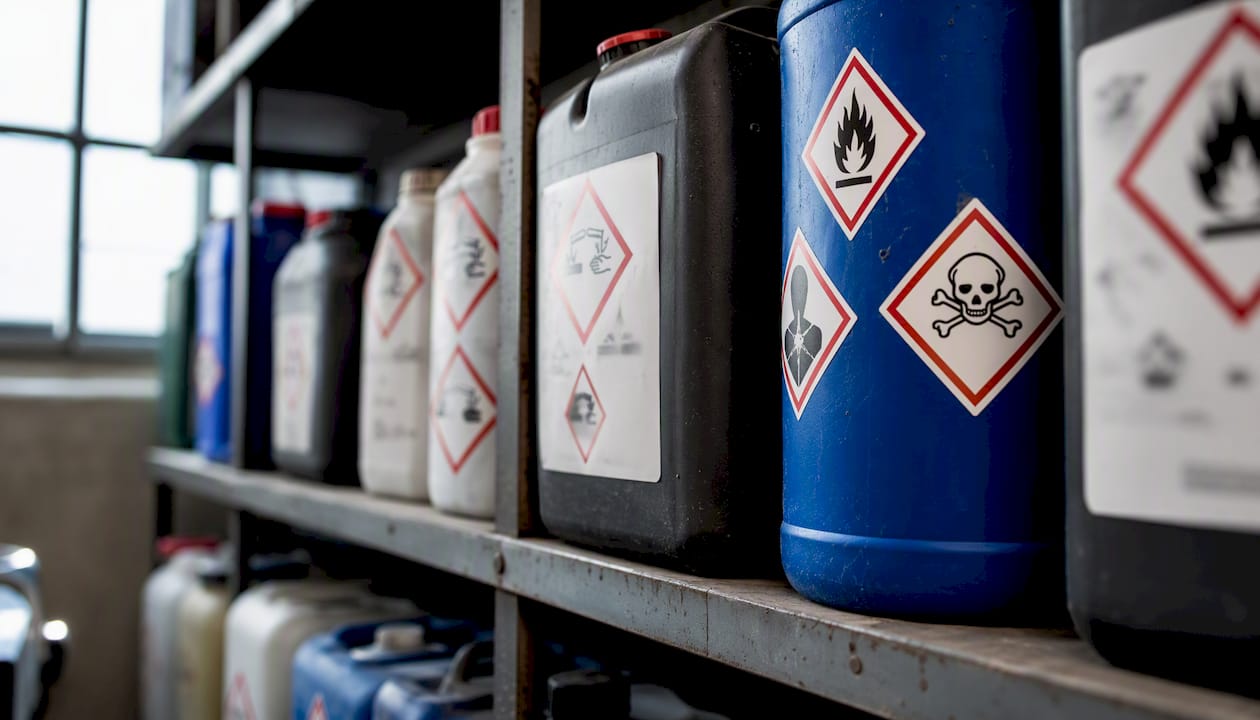
2. Hazardous substances What is asked: recognizing GHS symbols, reading safety data sheets, and choosing protective measures. Example question: Which symbol indicates that a substance is toxic when inhaled?
3. Work equipment What is asked: safe use of tools, machines, and lifting equipment. Example question: When can you use a damaged ladder?
4. Safe working and workplace design What is asked: LMRA (Last Minute Risk Analysis), toolbox meetings, and occupational hygiene strategy. Example question: What do you do if you discover an unsafe situation just before starting your work?
5. Personal protective equipment What is asked: which PPE corresponds to which risks and how to check if PPE is still usable. Example question: What protection is mandatory when working with grinding discs?
6. Emergency procedures and incident reporting What is asked: how to act in case of fire, a workplace accident, or a dangerous situation, and who to alert. Example question: What is the first step when discovering a fire in the workplace?
B-VCA versus VOL/VIL: what differs in scope?
| Topic | B-VCA (employee) | VOL/VIL (manager) |
|---|---|---|
| Regulations | Basic rules and personal responsibility | Legislation, enforcement, and managerial duties |
| Hazardous substances | Recognizing symbols and choosing PPE | Conducting risk assessments and establishing control measures |
| Work equipment | Recognizing safe use and inspection | Inspection obligations and selection criteria |
| LMRA and toolbox | Participating and applying | Organizing, leading, and documenting |
| Incident reporting | Reporting to the manager | Investigating, recording, and reporting |
The B-VCA can also be taken modularly through four partial exams, an option available for MBO Entry candidates. Module results are valid for a maximum of one year; those who pass all four modules receive the full B-VCA diploma.
What will the renewed exam look like from 2026?
The ETT 3.0 changes revolve around one core idea: less jargon, more recognizable work situations. The exam no longer tests whether you can memorize petrochemical terms, but whether you can make the right choice in a described work situation.
What this concretely means for you:
- Industry-neutral: the scenarios are recognizable for construction, technology, logistics, and industry at the same time. You do not need sector-specific knowledge.
- More question variation: in addition to regular multiple-choice, there will be multiple response, matrix, and matching questions. In multiple response, multiple answers can be correct at the same time.
- Risk recognition at the center: you read a situation description and determine what risk is present or what measure is appropriate.
- Less time per question for VOL/VIL: 60 questions in 60 minutes means an average of one minute per question, while the questions have become longer and more complex.
Pro-tip: Practice explicitly with multiple response questions. Many candidates read too quickly and choose only one answer, while the question asks for two or three correct answers. This unnecessarily costs points.
SSVV emphasizes that passing depends not only on factual knowledge but on the ability to interpret instructions and safety agreements in a practical context. For B-VCA, the language level is A2, for VOL/VIL it is B1. Those who doubt their reading level can use the Basismeter to determine if language support is needed.
How do you study efficiently with a summary and practice routine?
Three study plans depending on your time
Three-day plan (crash course) Day 1: read the ETT summary by chapter and note a maximum of five key points per topic. Day 2: take two full timed practice exams and mark errors by theme. Day 3: repeat only the weak themes and take one final test.

Seven-day plan (review) Spend the first four days on two core topics per day, with a short practice session of 15 minutes each time. Days five and six are for timed full practice exams. Day seven is solely for error analysis and targeted review.
Thirty-day plan (build-up) Week one: theory per chapter, noting concepts. Week two: targeted practice questions per topic. Week three: full timed practice exams. Week four: error analysis, review, and a final test.
How do you create an effective summary?
Use the VCA-ETT as a blueprint. Take each of the 12 chapters and write one sentence per assessment criterion: what must you be able to do (T) or what must you know (K)? Add one concrete example from a recognizable work situation. Keep it to one A4 per chapter.
Avoid long definitions. “Hazardous substances are substances that can cause harm” won’t help you on the exam. Better: “GHS08 = health hazard when inhaled or contacted; always wear PPE and consult the safety data sheet.”
Pro-tip: Write your summary by hand. This forces you to choose what is truly important, and the motor action enhances memory retention.
Practice routine in four steps
- Take a complete timed practice exam without interruption.
- Note for each mistake: which topic, which type of question (T or K), and why you were wrong.
- Repeat only the weak topics, not the entire exam.
- Schedule a retake moment if you score below 70% after three full practice exams.
Example questions to practice with immediately
Set a timer for 15 minutes and answer the questions below. On average, you have 1.5 minutes per question for B-VCA; for VOL/VIL, it is one minute.
Question 1 (B-VCA, knowledge-oriented) You see a GHS symbol with an exclamation mark on a container. What does this mean?
A. The container contains an explosive substance B. The container contains a substance that is irritating or harmful C. The container contains a toxic substance D. The container contains a flammable substance
Correct answer: B. The exclamation mark symbol (GHS07) indicates irritating, sensitizing, or harmful substances. Explosive is GHS01, toxic is GHS06, flammable is GHS02. This is a knowledge-oriented assessment criterion: you must know the symbols by heart.
Question 2 (VOL/VIL, application-oriented) An employee reports just before starting work that the scaffold feels unsafe. What do you do as a manager?

A. You let the employee start anyway and check later B. You stop the work, have the scaffold inspected, and only start when it is declared safe C. You ask the employee to check the scaffold themselves D. You report it at the end of the day in the incident register
Correct answer: B. This is an application-oriented question about LMRA and managerial responsibility. The manager stops work when there is doubt about safety. Answers A and C are incorrect because they do not directly resolve the unsafe situation; D is too late.
Question 3 (multiple response, B-VCA or VOL) Which two measures are part of the occupational hygiene strategy as the first step?
A. Implementing personal protective equipment B. Eliminating the source of the hazard C. Taking collective protective measures D. Providing instructions to employees
Correct answers: B and C. The occupational hygiene strategy works from source to person: first address the source (B), then collective measures (C), then organizational measures, and only as a last resort PPE (A). This is a multiple response question: both answers are required for a full point.
Pro-tip: For multiple response questions: first read how many answers are required. If it says “two answers,” then there are exactly two correct. Checking more or fewer will not earn points.
Where can you find reliable summaries and practice materials?
Use these sources
- SSVV website — the official ETT documents, the explanation of the VCA-ETT, and the amendment documents for ETT 3.0 are available for free at ssvv.nl. Always check the publication date and version.
The most reliable summary is the VCA-ETT itself. Any other document is an interpretation of it. Use supplementary material only if it explicitly refers to ETT 3.0 and has a publication date after 2024. You can recognize outdated material by petrochemical terms, lifting calculations, or spread angles: those topics have been removed from the general exam and belong in supplementary vocational training.
What you should avoid
- Old course books or PDF summaries without version numbers: there is a good chance they still contain ETT 2.x material.
- Sector-specific teaching materials for petrochemicals or offshore: these are no longer part of the general VCA exam.
- Summaries from third parties without reference to the ETT assessment criteria: you don’t know what you’re missing.
Practical download tip: go to ssvv.nl, search for “ETT” and download both the ETT itself and the explanation. Note the transition regulation for educational institutions: they may still use the old material for a certain period, but you as a candidate will be tested on the current version.
Why does timed practice work better than rote memorization?
SSVV states that passing depends on interpretive ability, not on memorizing definitions. ETT 3.0 measures exactly that: can you read a situation, recognize the risk, and choose the right measure? Candidates who only memorize theory struggle with scenario questions because they require a different thought process.
Timed practice trains two skills at once: reading ability and time management. For VOL/VIL, you have an average of one minute per question. Those who are not used to reading and deciding quickly lose valuable time on the longer scenario questions. This is not a knowledge problem, but a practice problem.
- Daily short sessions (15–20 minutes) are more effective than one long study session per week.
- Weekly error analysis by assessment criterion shows whether your weak points are structural or coincidental.
- Scenario training with LMRA, toolbox, and occupational hygiene strategy prepares you for the application-oriented questions that weigh the most.
Pro-tip: After each practice exam, make a list of errors by theme. If you get “hazardous substances” wrong three times, that’s not bad luck but a signal. Spend the next session solely on that theme.
Quick links to recognized sources and tools
Here you will find the most important official documents and tools:
- VCA-ETT and explanation — ssvv.nl — download the ETT and the explanation of the final and assessment criteria directly from the SSVV website.
| Source | What you find there | Free? |
|---|---|---|
| SSVV (ssvv.nl) | ETT, explanation, amendment documents, exam centers | Yes |
| Central Diploma Register | Diploma verification and registration | Yes |
| Basismeter | Language level test for exam guarantee | Yes |
| Vcaproefexamen | Timed practice exams, error analysis, free demo | Demo free |
The renewed exams require practice platforms that simulate matrix and multiple response questions. A platform that only offers regular multiple-choice does not fully prepare you for the current exam format.
What a VCA trainer would tell you about common mistakes
The most common mistake is not insufficient knowledge. It is having practiced too little under time pressure. Candidates who read the theory calmly at home and then realize for the first time in the exam that they have to answer 60 questions in 60 minutes become confused. Not because the questions are too difficult, but because the reading pace is incorrect.
A second pitfall: not reading the question carefully. In scenario questions, the key word is sometimes halfway through the sentence. “What do you do as a manager” asks for a different answer than “what do you do as an employee.” Those who read quickly and miss that word choose the wrong answer.
On exam day itself: first read the question completely, mentally mark the key word, and then answer. Use the review option at the end of the exam for questions you were unsure about. Do not skip questions without marking them for review.
Reading ability is part of the exam, not a side issue. Candidates with a lower language level must address this well before the exam using the Basismeter and possibly arrange language support through the exam center.
Vcaproefexamen helps you practice as if the exam is real
The difference between a practice exam at home and the real exam lies in the time pressure and question variation. Vcaproefexamen simulates both: a built-in timer, realistic scenario questions including multiple response and matrix, and immediate feedback on each question with explanations of why an answer is correct or incorrect.
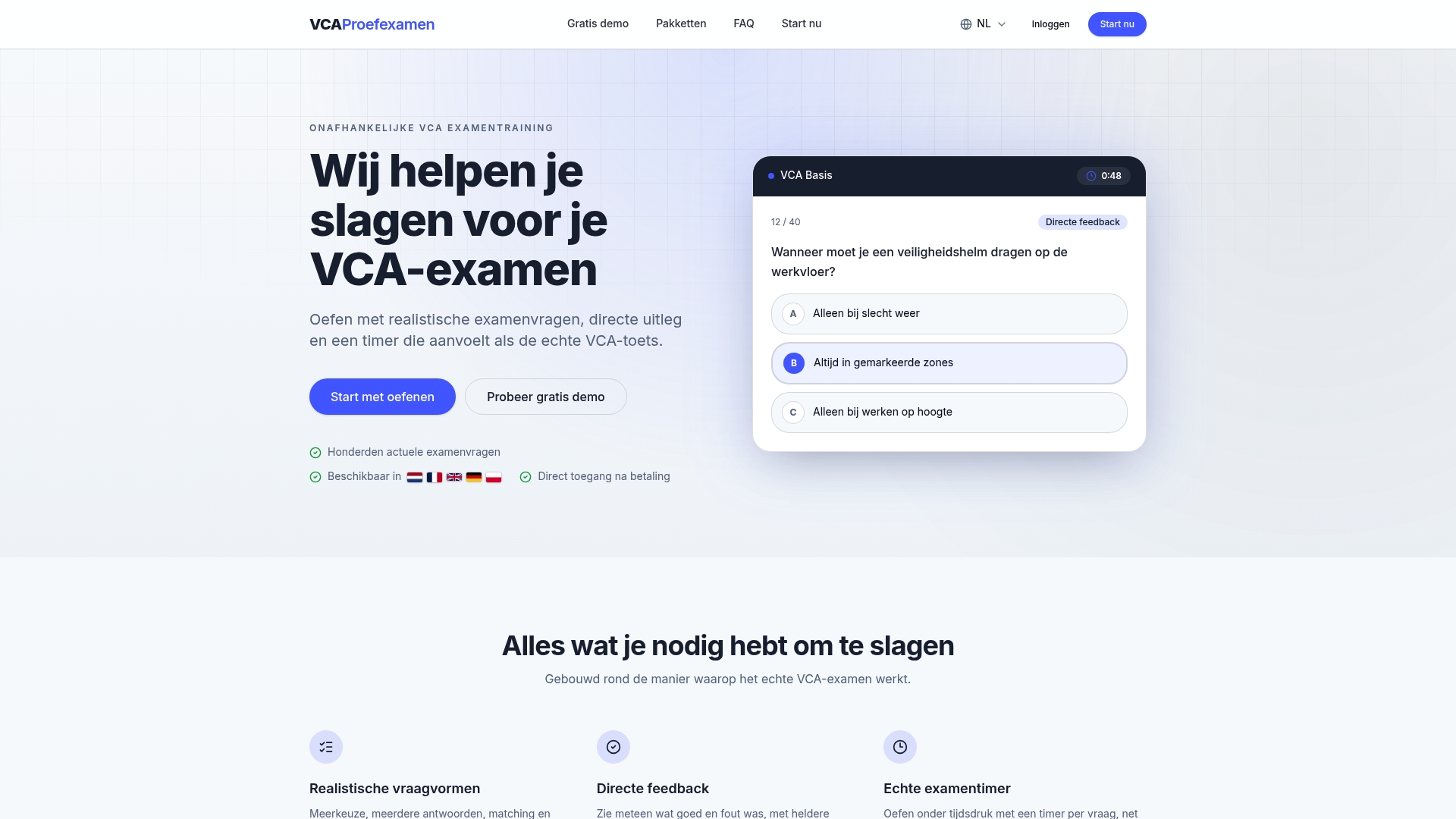
You choose an access package of 3, 7, or 30 days, depending on how much time you have. There is no subscription and no automatic renewal. The multilingual interface (Dutch, French, English, German, Polish) makes the platform usable for candidates who do not take the exam in their native language. Error analysis by theme shows you exactly where your time is best spent.
Want to see how it works first? The free demo on Vcaproefexamen starts without registration. This way, you know within five minutes if the approach suits you before purchasing a package.
Sources
Official documents that support your preparation:
Note the transition regulation: educational institutions may temporarily still use the old material, but the exam itself already tests on ETT 3.0. As a candidate, you will be assessed on the new version, regardless of which teaching material your course uses.
Frequently Asked Questions
What do you need to learn for the VCA exam?
You will learn the six core topics from the VCA-ETT: regulations and safety rules, hazardous substances, work equipment, safe working and workplace design, PPE, and emergency procedures. The ETT 3.0 emphasizes risk recognition and application in work situations, not memorizing definitions.
What do example questions for the VCA exam look like?
Questions describe a work situation and ask what measure you would take or what risk is present. In addition to regular multiple-choice questions, there are also multiple response, matrix, and matching questions where multiple answers can be correct at the same time.
Is the VCA exam difficult?
The exam is manageable with the right preparation, but time pressure is a serious factor: for VOL/VIL, you have an average of one minute per question. Candidates who are not used to reading scenario texts quickly often struggle with this.
What percentage passes the VCA exam?
An official pass rate is not publicly published by SSVV. What is known is that candidates who practice with timed mock exams and perform error analysis by theme are better prepared for the time pressure and question variation of the actual exam.
Where can I practice for my VCA exam for free?
SSVV publishes official ETT documents and sample materials on ssvv.nl. For timed practice exams with immediate feedback, Vcaproefexamen offers a free demo without registration via Vcaproefexamen.